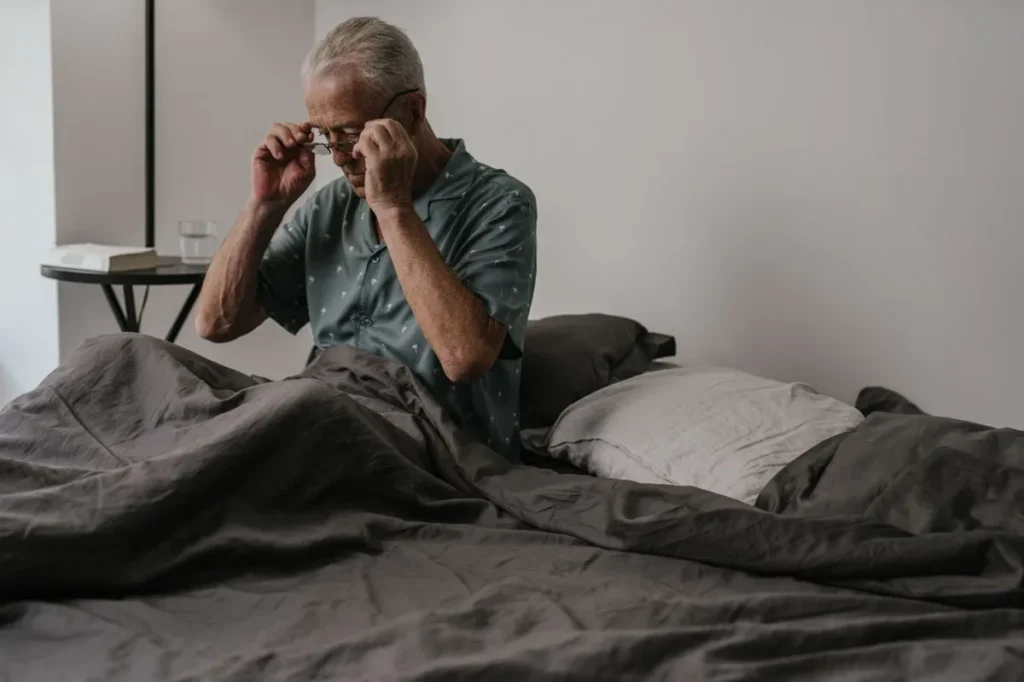
For almost three years I got up to pee two, three, sometimes four times a night. I told myself it was age. I told my wife it was the coffee. Then Marianne started sleeping in the guest room, not because we were fighting, but because she wanted one night without the bathroom door and the flush at 3 a.m.
That is when I stopped guessing and started measuring. This page is what I learned, in the order I wish someone had told me. I am not a doctor. I am a retired structural engineer, and I treated my nights the way I used to treat a beam that kept cracking: find the load first, then fix it.
Men wake up to pee at night for two main reasons: the body makes too much urine after dark, or the bladder cannot hold or empty well, often because of an enlarged prostate. Fixes depend on which one you have. Logging three nights tells you which, and most changes start with timing, not cutting water.
Why do I wake up to pee at night?
This is the question most men type first, and the honest answer is that “waking up to pee” is not one problem. It is two, and sometimes both at once.
Problem one: your body makes too much urine at night. When you were 30, your body slowed urine production while you slept. With age that slowdown weakens, and a bigger share of the day’s urine gets made at night. The Sleep Foundation lists the usual suspects: drinking late, caffeine and alcohol in the evening, and fluid that pools in your legs during the day and gets turned into urine once you lie down.
Problem two: your bladder cannot hold it or cannot empty it. This is where the prostate comes in. The prostate wraps around the tube urine leaves through, and for most men it keeps growing with age. According to the National Institute of Diabetes and Digestive and Kidney Diseases, an enlarged prostate (doctors call it BPH) affects roughly 29% to 33% of men 65 and older, and getting up at night is one of its listed symptoms. If the bladder never empties all the way, it fills back up faster, and you are up again at 2 a.m.
And a third one nobody mentions: your sleep itself. Snoring and pauses in breathing at night (sleep apnea) change how much urine the body makes. In a 2004 study of older adults, people with more severe apnea made more urine overnight. If your wife says you snore or stop breathing, that may be part of your bathroom problem.
First, find out which one you have: the three night log
This is the part I am proudest of, and it costs nothing.
Doctors call it a bladder diary. A review in the Journal of Urology called these charts “invaluable” for figuring out what is behind night urination, precisely because the causes are so mixed. Here is how I did mine:
- Put a cheap plastic measuring cup in the bathroom. Yes, really.
- For three days, write down every time you pee and roughly how much, day and night.
- Write down what you drank, when, and when you went to bed and got up.
- Note anything else: a beer at dinner, a late coffee, swollen ankles, a bad night of snoring.
Then look at the night entries. If you are getting up and producing a lot each time, your body is making too much urine at night, and the fixes are about timing, legs and sleep. If you are getting up and only a little comes out, the problem is more likely storage or emptying, which points toward the prostate or the bladder.
My own log surprised me. I was sure it was the prostate. It was partly the prostate and partly two glasses of iced tea I drank every night watching the ballgame, which I had never once counted as “fluid”.
Take the log to your doctor too. It turns a ten minute appointment where you say “I go a lot at night” into a real conversation.
How to stop waking up to pee at night: what actually helps
These are the changes that made a difference for me, roughly in the order I would try them. None of them is magic. Together they add up.
1. Move your water, do not cut it
Every man I know tried “no water after 8 p.m.” and most of them are still getting up. Cutting water hard can leave you dehydrated, and that is not the trade you want. The Sleep Foundation’s advice is to drink less before bed while staying properly hydrated.
What works better is moving it. Drink most of your water before mid afternoon, then taper. In the last couple of hours before bed, sip only if you are thirsty. The total stays the same. The timing changes.
2. Pull caffeine and alcohol earlier
Both make your kidneys produce more urine, and both linger. The Sleep Foundation recommends cutting them back in the afternoon and evening, not just at bedtime. For me that meant the last coffee before lunch and the ballgame iced tea switched to a small glass, early in the game. Count iced tea, soda and decaf too. Decaf still has some caffeine.
3. Put your legs up an hour before bed
This one sounds silly and it is the one I would least want to give up. If your ankles are a little puffy by evening, that fluid goes back into your blood when you lie flat, and your kidneys turn it into urine around 1 a.m.
The fix is to let that happen before bed instead. Sit with your feet up, above hip level if you can, for an hour or so in the evening, then go to the bathroom before you turn in. The Sleep Foundation lists the same trick. If your legs swell a lot, ask your doctor about compression socks during the day.
4. Empty twice before bed
Pee, wait a minute or two, then try again. Men with a slow or weak stream often leave some behind on the first try. It takes two minutes and it is the cheapest thing on this list.
5. Look at your pills, and at what you take for a cold
If you take a “water pill” (a diuretic) for blood pressure in the evening, ask your doctor whether it can move to the morning. Never change it on your own.
Something I did not know: the NIDDK notes that some over the counter cold and cough medicines can make prostate symptoms worse. If your nights got bad during a cold, that may be why.
6. Take the snoring seriously
If you snore loudly, wake up gasping, or feel wrecked after a full night in bed, ask about a sleep test. Treating apnea is a medical decision, but it is one of the few fixes that helps the sleep and the bathroom trips at the same time.
7. If the log points to your prostate
If your stream is weaker than it used to be, you feel like you did not finish, or you get up and only a little comes out, the prostate is the likely load. Start with a doctor’s visit. There are real medical options and you deserve to know them.
Many men also try a prostate support supplement alongside that, usually saw palmetto, pygeum or pumpkin seed. I did. Supplements support prostate and urinary function; they do not treat or shrink anything, and they take weeks, not days. If you want to see what I tried and what the complaints about it actually say, I wrote it all up in my ProstaFense review.
How to stop peeing at night naturally: what is not worth your money
The internet is full of “stop night peeing in 4 minutes” tricks. I tried a few. Here is my short list of what did not hold up:
- Cutting all water after dinner. Covered above. Moving water helps; starving yourself of it backfires.
- Holding it to “train” your bladder at night. Lying awake holding it is not sleep. Bladder training is a real thing, but it is done during the day, with guidance.
- Cranberry anything. It gets suggested for bladder infections. I found nothing that makes it a prostate fix.
- A bottle you take for ten days. Whatever you try, nothing in this category works on a ten day clock.
What to take from Reddit threads about it
I read a lot of Reddit threads on this, because like most men my age I wanted to hear from someone in the same boat, not from a brochure. Over time I learned to read them with three questions.
How old is he? Advice from a 30 year old who got up once after a party does not apply to a 62 year old who gets up three times every night.
Did he come back? A post that says what a man tried and what happened weeks later is worth ten that say what he plans to try.
Was he ever checked? “It turned out to be my prostate” only means something if a doctor actually looked.
A thread is good for knowing you are not alone. It is not good for deciding what is going on in your own body. That is what the log and the doctor are for.
When waking up to pee is a reason to see a doctor
I waited almost two years to get checked. I was afraid I would hear “it’s just age”, and more afraid I would hear something worse. Neither fear was a good reason to wait.
Here is something that calmed me down: the common enlarged prostate is, in the NIDDK’s words, growth that is “not caused by cancer”. Getting up at night is extremely common at our age and usually has an ordinary explanation. But a doctor is the one who rules things out, not a website.
Go soon, not “someday”, if you notice any of these. The NIDDK lists them as reasons to call right away:
- You cannot urinate at all.
- You see blood in your urine.
- You have painful, frequent, urgent urination with fever and chills.
- You feel a lot of pain in your lower belly or urinary tract.
Also bring it up at your next visit if you are suddenly very thirsty, losing weight without trying, short of breath when you lie down, or if the night trips came on fast over days instead of slowly over years. Those point away from the prostate and toward things your doctor should check.
Frequently asked questions
How many times is normal to wake up to pee at night? Getting up once is very common after 60 and many doctors do not worry about it. Twice or more is when it usually starts to cost you real sleep and is worth bringing up with your doctor.
Is waking up at night to pee a sign of diabetes? It can be one sign, usually together with strong thirst, peeing a lot during the day too, or weight loss you cannot explain. A simple blood test answers the question, so ask for one rather than worrying about it.
Why do people say waking up to pee is a dental problem? The idea comes from dentists who screen for sleep apnea. Mouth breathing and snoring can point to apnea, and apnea is linked to making more urine at night. The link runs through your breathing, not your teeth.
Does stopping water before bed stop the night trips? It helps a little for some men, but cutting water hard can backfire. Moving most of your drinking earlier in the day, while staying hydrated, works better than going thirsty.
Why do I wake up to pee at the same time every night? Often it is a timing pattern: a drink, a pill or fluid from your legs reaches the bladder at about the same hour each night. A three night log usually shows what lines up with it.
What is the best way to prevent waking up to pee at night? Start with timing: drink most of your water earlier, move caffeine and alcohol to the afternoon, put your legs up for an hour before bed and empty twice before you turn in. If that is not enough, a three night log and a doctor’s visit come next.
Can a supplement help me stop waking up to pee? Prostate support supplements can support urinary function in some men, over weeks rather than days. They do not treat any disease and they are not a reason to skip the doctor. Start with the free fixes on this page first.
Keep reading
Dale Prescott is a retired structural engineer in Fort Collins, Colorado. He is not a medical professional, and nothing on this page is medical advice. Talk to your doctor before changing any medication. Some pages on this site contain affiliate links, which means The Night Flow Report may earn a commission if you buy through them, at no extra cost to you.